MASE certification (Manuel d’Amélioration Sécurité des Entreprises, or Manual for Improving Safety in Companies) is a QHSE (Quality, Health, Safety, Environment) standard that helps companies structure their safety management systems to protect employee health and minimize occupational risks. It is particularly aimed at industrial and construction sectors where risks are numerous, but its benefits extend far beyond safety issues alone. Adopting MASE certification also means choosing to strengthen your company's performance, brand image, and competitiveness.
This article examines the benefits of MASE certification and provides an overview of the certification process to better understand the compliance and safety approach.
Why choose MASE certification?
MASE certification is intended for companies that wish to improve their safety practices, but also give their business a competitive advantage. Here are the main benefits of this label.
A structural improvement in safety
MASE certification enables companies to structure their safety management. By integrating its requirements, they adopt a preventive approach to risk. This certification promotes the implementation of clear and demanding procedures, which translates into a reduction in workplace accidents and a general improvement in working conditions. It also requires constant vigilance in terms of safety, encouraged by regular audits.
For example, the MASE standard encourages companies to:
- Identify and assess the risks associated with each workstation
- Train employees on safety best practices
- Create monitoring protocols to ensure equipment and facilities comply with regulations.
A strengthened brand image
In a context where safety and compliance criteria are increasingly valued by customers and partners, MASE certification provides an additional guarantee. It demonstrates the company's commitment to safety and hygiene, which enhances its image. In sectors where safety is essential, such as construction, chemicals, and heavy industry, the MASE label often becomes a compelling argument when awarding contracts.
In addition, MASE-certified companies appear more reliable and are seen as trusted partners, which can increase their credibility in often demanding markets.
A major competitive advantage
Obtaining MASE certification gives companies a strategic advantage over their competitors. In fact, in calls for tenders or public procurement, this label is often a prerequisite for bidding. Certified companies are therefore better positioned to seize business opportunities.
In addition, this certification helps optimize costs related to workplace accidents and incidents. Reducing the risk of accidents often leads to a decrease in sick leave and associated expenses, enabling the company to remain competitive while improving its profitability.

MASE Certification Process: Steps and Requirements
Obtaining MASE certification is not a one-off task, but a structured project that requires several steps to be followed. This rigorous process ensures that candidate companies comply with the required safety standards and implement a continuous improvement approach.
Understanding the requirements of the MASE standard
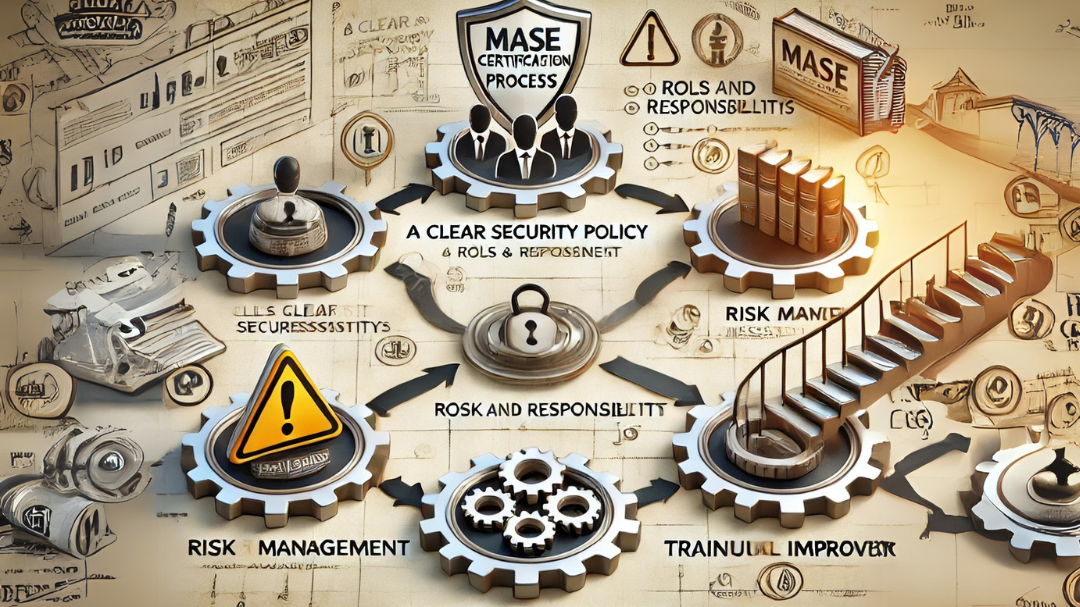
The MASE standard is based on five main areas that structure the company's safety management system:
- Security policy: the company must develop a clear policy covering security principles and objectives.
- Organization and responsibilities: this involves defining everyone's roles and responsibilities in terms of security and ensuring effective communication.
- Risk management: identifying and assessing risks is essential for implementing appropriate preventive measures.
- Training and awareness: every employee must be trained in the safety procedures and hygiene measures in force.
- Continuous improvement: MASE certification requires constant re-evaluation of procedures and adaptation in line with technological or organizational developments.
Preparation and compliance phase
Before embarking on the certification audit, companies must prepare by implementing a management system that complies with the standard. This involves:
- The creation of a steering committee to coordinate efforts and ensure compliance
- Implementation of operational procedures for risk management and employee training
- Conducting internal audits to assess discrepancies and identify necessary corrective actions.
The preparation phase may require external support to facilitate the implementation of the MASE system, particularly for companies that do not have specialized QHSE departments.
Certification audit
The MASE certification audit is a key step in validating the company's compliance. To maximize its chances of success, it must gather documents proving compliance with standards: safety policies, training completed, accident reports, prevention protocols, etc.
Auditors will analyze the procedures in place and verify their application in the field. Companies must therefore ensure that all teams are involved in this process, as insufficient preparation could compromise the success of the audit.
Combien coûte une certification MASE ?
Le coût d’une certification MASE varie selon plusieurs critères : la taille de l’entreprise, le nombre de sites concernés, le niveau de maturité du système SSE déjà en place, l’accompagnement éventuel par un consultant, les formations à prévoir et les frais liés à l’audit de certification.
Il ne s’agit donc pas uniquement d’un coût d’audit. Le budget global peut inclure la mise à jour des procédures, la formation des équipes, la préparation documentaire, les audits internes et les actions correctives à mettre en place avant l’audit final.
Validity and renewal of certification
Once obtained, MASE certification is valid for a period of 1 to 3 years. Follow-up audits are conducted to verify the company's ongoing compliance. These regular reassessments encourage companies to maintain their good practices and improve them over time.
Renewing certification is also an opportunity for companies to reassess their procedures and strengthen their internal security skills.
The profitability of MASE certification: A long-term return on investment
Although MASE certification represents an initial investment (audit costs, compliance, training), its benefits are often positive and result in long-term savings. By reducing incidents and improving risk management, it helps to lower costs related to workplace accidents, sick leave, and penalties. In addition, companies gain in productivity because processes are better structured and employees are more confident in their work environment.
In addition, the improved brand image made possible by MASE certification facilitates the retention of existing customers and the acquisition of new markets.
The use of available tools to prepare for and facilitate obtaining this certification should not be overlooked. For example, 16% of workplace accidents in the construction industry are due to equipment that has not been properly monitored or maintained. In this sense, an equipment monitoring and management tool can be a considerable asset in this process.
By facilitating the management of safety, compliance, and equipment traceability. Our solution meets certain MASE requirements:
Organization and responsibilities
Traceability and centralization of information: Our centralized management platform allows you to accurately track which equipment is being used, by whom, and where. This facilitates the distribution of responsibilities and enables clear and documented management of interventions and maintenance.
Training and awareness
Tracking and access to documentation: Our solution allows users to easily access information about each piece of equipment, which is essential for raising awareness and training teams on the specific features of each piece of equipment. By scanning a QR code or via Bluetooth, employees can obtain details on the condition and instructions for use.
Continuous improvement
Tracking equipment movements and status: By providing a real-time view of the use, location, and condition of each piece of equipment, we enable data collection for analysis and continuous improvement of equipment management processes. This feature supports internal audits and continuous improvement, in line with MASE expectations.
Security policy
Incident prevention through traceability: Geolocation and automatic inventory reduce errors and oversights, ensuring that equipment is in good condition and available when needed. By better controlling the location and condition of equipment, we minimize interruptions and ensure increased safety.
In short, our solution enables companies to effectively structure and document their equipment management processes, thereby meeting MASE requirements in terms of safety, compliance, and traceability.
Tips for successful MASE certification
To maximize their chances of success during certification, companies must:
- Involve management and employees from the outset: this promotes acceptance of new practices and ensures better enforcement of safety rules.
- Conduct regular internal audits to identify non-compliance issues before the official audit.
- Document safety practices: Auditors will analyze documented evidence of compliance, such as accident reports, training records, and internal audits.
- Call on experts: support from specialized consultants can be an asset in better understanding the requirements of the standard and structuring the certification process.
Mistakes to avoid in the certification process
Certain errors can compromise the success of MASE certification. Among the most common are:
- Lack of preparation: embarking on the audit without being sufficiently prepared exposes the company to non-compliance issues that could delay certification.
- Insufficient documentation: an incomplete file may lead to failure during the certification audit.
- Underestimating training: Training employees is essential to ensure that they apply new safety procedures. Neglecting this aspect can damage the company's credibility.
Charlie Solutions et la certification MASE
Avec Charlie Solutions, les entreprises peuvent centraliser les informations liées à leurs équipements : localisation, statut, affectation, historique d’utilisation, documents associés, dates de contrôle et rappels de maintenance.
Concrètement, cela permet de :
- mieux tracer les équipements utilisés sur site ;
- identifier rapidement le matériel non conforme, perdu ou immobilisé ;
- faciliter l’accès aux documents de contrôle et de maintenance ;
- automatiser les rappels liés aux vérifications périodiques ;
- fournir des données fiables lors des audits internes ou externes.
Pour les responsables QHSE, responsables matériels ou directions d’exploitation, Charlie Solutions aide à transformer la conformité en routine terrain. Moins de fichiers dispersés, moins d’oublis, plus de visibilité.
Dans une démarche MASE, le suivi de conformité du matériel aide les entreprises à documenter leurs contrôles, leurs maintenances et leurs actions de prévention.
In conclusion: A strategic choice for businesses
Ultimately, MASE certification is a strategic investment that contributes to the sustainability, growth, and image of the company. By committing to this process, companies demonstrate their desire to improve their internal processes, ensure the safety of their employees, and position themselves as reliable and competitive players.
For those who wish to learn more, it is recommended that you consult an accredited organization or seek specialized resources to effectively prepare for certification. We can also help you meet some of the MASE requirements.
Frequently Asked Questions
Combien coûte une certification MASE ?
Le coût d’une certification MASE dépend de la taille de l’entreprise, du nombre de sites à certifier, du niveau de préparation initial, des éventuelles formations nécessaires, de l’accompagnement externe et des frais d’audit. Le budget doit donc intégrer à la fois la préparation, la mise en conformité et l’audit de certification.
Quels sont les axes du référentiel MASE ?
Le référentiel MASE repose sur 5 grands axes : l’engagement de la direction, les compétences et qualifications professionnelles, l’organisation du travail, l’efficacité du système de management, ainsi que le bilan et l’amélioration continue.
Combien de temps faut-il pour obtenir la certification MASE ?
La durée nécessaire pour obtenir la certification MASE varie selon la maturité de l’entreprise en matière de sécurité. Une entreprise déjà structurée pourra avancer plus rapidement, tandis qu’une organisation partant de zéro devra prévoir plus de temps pour formaliser ses procédures, former ses équipes et réaliser ses audits internes.
Quelle est la durée de validité de la certification MASE ?
La certification MASE est généralement délivrée pour une durée de 1 à 3 ans. Cette durée dépend des résultats de l’audit et du niveau de maîtrise du système de management Santé, Sécurité et Environnement de l’entreprise.
Comment Charlie Solutions peut aider dans une démarche MASE ?
Charlie Solutions aide les entreprises à mieux suivre leur matériel, leurs contrôles, leurs statuts de conformité et leurs rappels de maintenance. La plateforme centralise les données terrain et facilite la traçabilité des équipements, ce qui peut soutenir les démarches de sécurité, de conformité et d’amélioration continue.