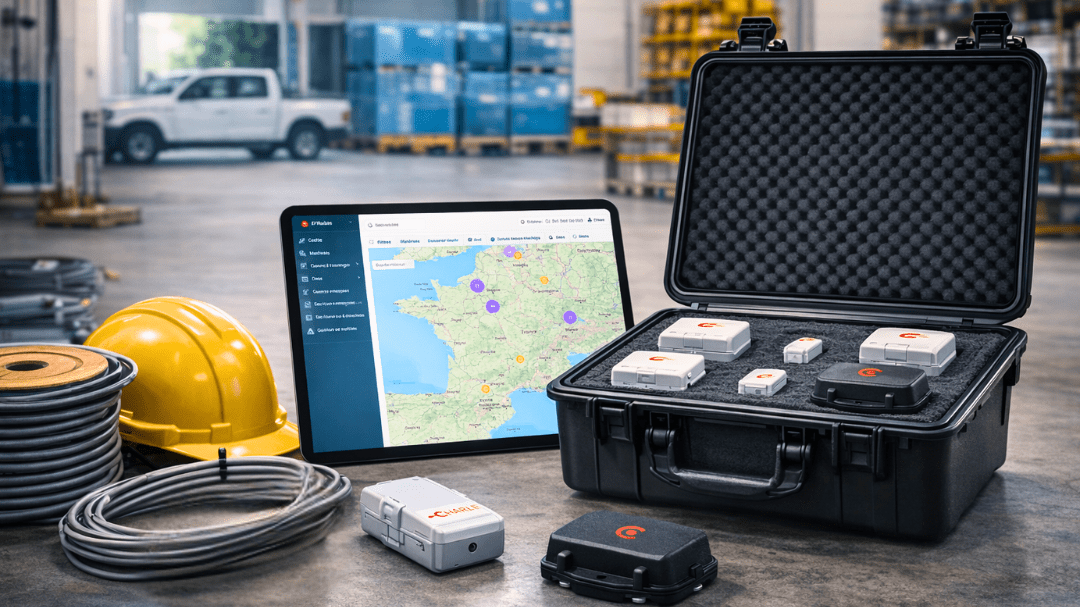
Waste collection has become a strategic operational challenge for local authorities, private operators, and recycling companies. The increase in waste volume, rising logistics costs, and regulatory pressure require more precise and rigorous management of equipment. In France, the waste management sector mobilizes more than 250 million dumpsters and containers handled each year, according to ADEME, which represents a growing complexity in terms of tracking, optimizing routes, and securing equipment. In this context, IoT traceability solutions, integrating the geolocation of dumpsters using BLE sensors, industrial GPS boxes, and supervision platforms such as Charlie Gestion, are becoming essential for transforming a fleet of dumpsters into a pool of smart, visible, and remotely controllable assets.
Real-time tracking: a major asset for reducing logistics costs
Geolocation of dumpsters allows operators to view the exact position of each piece of equipment in real time. IoT sensors equipped with industrial GPS enable the entire fleet to be displayedon a dynamic map ,whether it consists of compactor dumpsters, removable dumpsters, or rubble dumpsters. This visibility eliminates time-consuming searches, assignment errors, and unnecessary travel, which account for an average of more than 12% of kilometers traveled, according to a Federec study published in 2023.
In practice, an operator can immediately identify a dumpster that has been immobilized on a construction site for longer than expected, locate a dumpster that has been placed in the wrong location, or verify that a strategic container is located near a scheduled route. This dynamic management improves collection punctuality, ensures container availability, and directly reduces fuel consumption, which can account for up to 30% of operational costs in waste collection.
Complete mobility history: a valuable tool for improving route performance
Beyond instant geolocation, industrial IoT makes it possible to reconstruct the complete history of movements. Each dumpster becomes a traceable asset, thanks to dumpster tracking, which records site visits, downtime, routes taken, and any unplanned transfers. This digital memory, generated by IoT waste tracking,offers a considerable advantage when it comes to analyzing route performance.
Historical data accurately reveals periods of underutilization, areas where dumpsters are regularly overlooked, sites generating lower-than-expected turnover, or routes with frequent detours. This enables companies to rebalance their fleets, adjust their planning, and reduce productivity losses associated with idle equipment. According to consolidated feedback from ADEME in 2024, some local authorities that have adopted IoT traceability have seen an average 18% reduction in the number of kilometers traveled per bin collected.
Simplification of daily operations: smoother management that is less dependent on field conditions
Manually managing a fleet of dumpsters is often complex. Between temporary deposits, fast-paced construction sites, multi-stakeholder areas, and public deposits, equipment often temporarily disappears from operational view. Agents waste time, routes become disorganized, and collections must be postponed.
Thanks to IoT sensors, monitoring becomes centralized and predictive. Teams have a consolidated view of filling, movements, and availability. Planning for waste disposal or construction site deposits becomes more reliable, as it is based on verified data rather than approximate reports. This reduces field calls, minimizes communication errors, and allows for more rational resource allocation.
Collection companies, particularly in the construction and public works sectors, generally see productivity gains of between 10% and 20% in the first year of using an IoT solution, according to data provided by several operators in the sector.
Securing equipment fleets: an essential response to the rise in theft and misappropriation
The theft or temporary disappearance of dumpsters is a growing problem. Metal containers, particularly removable dumpsters, can be resold or diverted to other construction sites without authorization. In France, more than 7% of losses reported by waste collection companies concern containers that have not been recovered, according to the FNADE 2023 report.
IoT traceability significantly increases security. Geofencing systems automatically trigger an alert when a dumpster crosses into an unauthorized area. Charlie Gestion's real-time monitoring allows you to immediately display suspicious routes, notify managers, and speed up recovery procedures. Companies that equip their dumpsters with GPS tracking often see a reduction of nearly 50% in unexplained disappearances, as the mere presence of a tracker acts as a deterrent to malicious actors.
Security is not just about theft. It also helps reduce risks associated with inappropriate use, such as when a dumpster is used outside of authorized hours, illegally dumped, or moved to environmentally hazardous areas. The IoT thus becomes a compliance tool, facilitating controls and supporting internal responsible management policies.
Charlie Solutions: a comprehensive, robust IoT approach tailored to the needs of waste management professionals
The integration of IoT into the recycling and collection industries is only valuable if it is based on reliable technology designed for demanding environments. This is precisely the ambition of Charlie Solutions. Thanks to rugged industrial BLE sensors, GPS boxes designed to operate outdoors for long periods of time, and a comprehensive platform such as Charlie Gestion, operators have a coherent and operational ecosystem for supervising their fleet.
All information from the sensors is consolidated in a single interface, allowing users to view each skip, access its detailed history, trigger smart alerts, collaborate between departments, and monitor the overall status of their fleet. The platform has been designed to adapt to real-world situations: multi-site construction sites, collections in dense urban environments, very fast rotations in industrial areas, and management of remote depots.
Thanks to this integrated approach, companies become more responsive, reduce their logistics costs, and secure their equipment for the long term.
Conclusion
IoT traceability for waste collection bins is no longer an option for local authorities and waste collection companies: it is becoming a strategic lever for modernizing waste management. Real-time geolocation, historical analysis, operational simplification, and enhanced security improve the economic and environmental performance of the service. In a context of ecological transition and growing regulatory pressure, digitizing your fleet of dumpsters with a robust IoT solution such as Charlie Solutions represents a concrete step toward more efficient, safer, and more sustainable management.